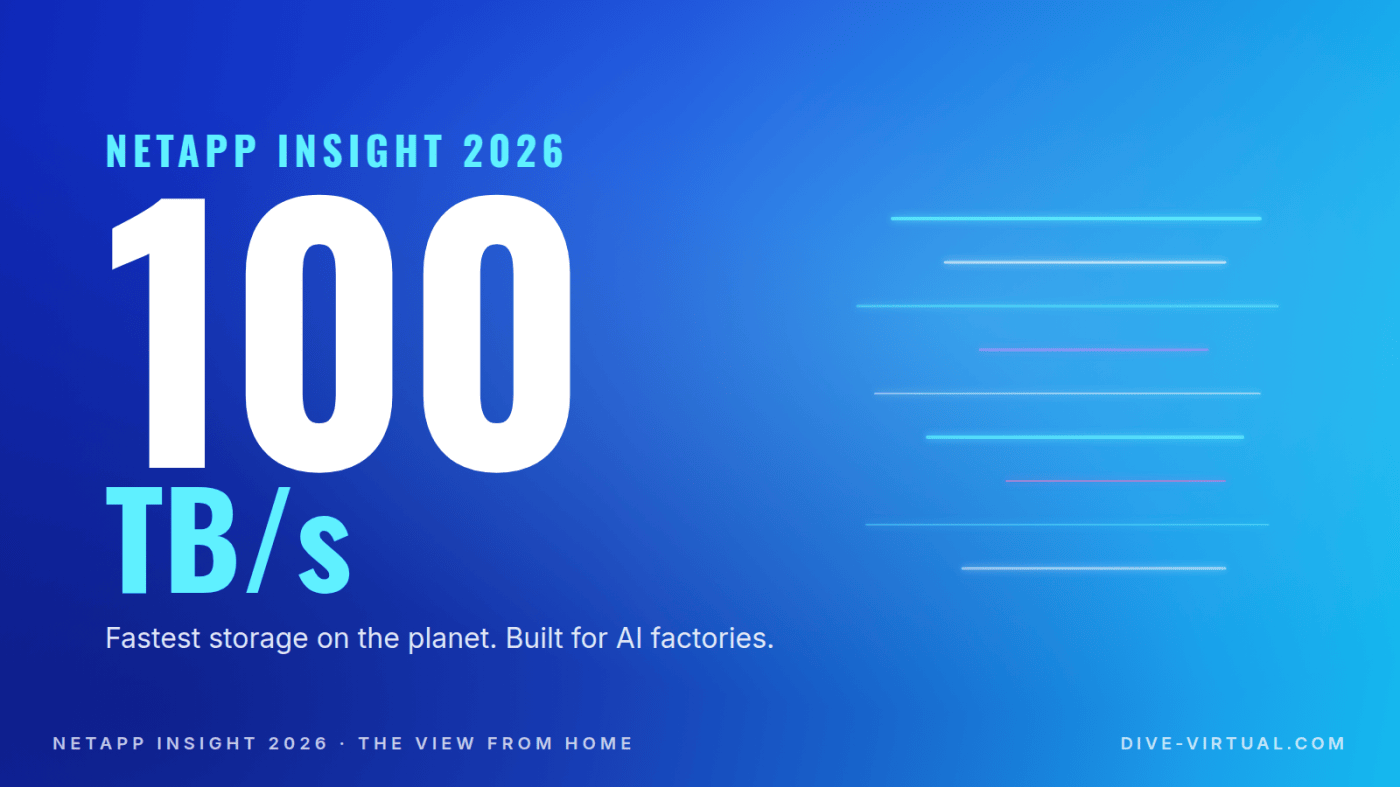
Every year after NetApp Insight, my LinkedIn feed looks the same. A photo of a big stage in Las Vegas, a big number, and the words “game changer”. This year the big number is 100 terabytes per second. And to be fair, that is a very big number.
This year I skipped Vegas, and for a very good reason. From Thursday to Sunday we were in Sitges for ITQonnect Days 2026, where we celebrated 25 years of ITQ. Insight started the very next Monday. Flying home from Spain and straight on to Las Vegas was simply too much, with family at home, a lot of travel and an energy level that was, let’s say, well used after a 25th birthday party. So after two years at Insight as a NetApp A-Team member, I followed it from a distance this time. And watching from the sidelines has one big advantage: you notice what gets lost in the noise of the show floor.
But let me be honest with you. Unless you are building an AI factory with tens of thousands of GPUs, you will not buy NetApp Novus next quarter. Neither will most of the organisations I talk to. Hospitals, schools, insurers and governments have a different list of worries: data spread over too many places, a VMware renewal on the desk, and a ransomware scenario that keeps the CISO awake at night.
So I did something else. Instead of writing the hundredth summary, I went looking for the announcements that got two minutes of stage time, but will change real conversations on Monday morning. I found three. And I found a few small surprises in the fine print.
1. A free exit ticket you may never use (but should have)
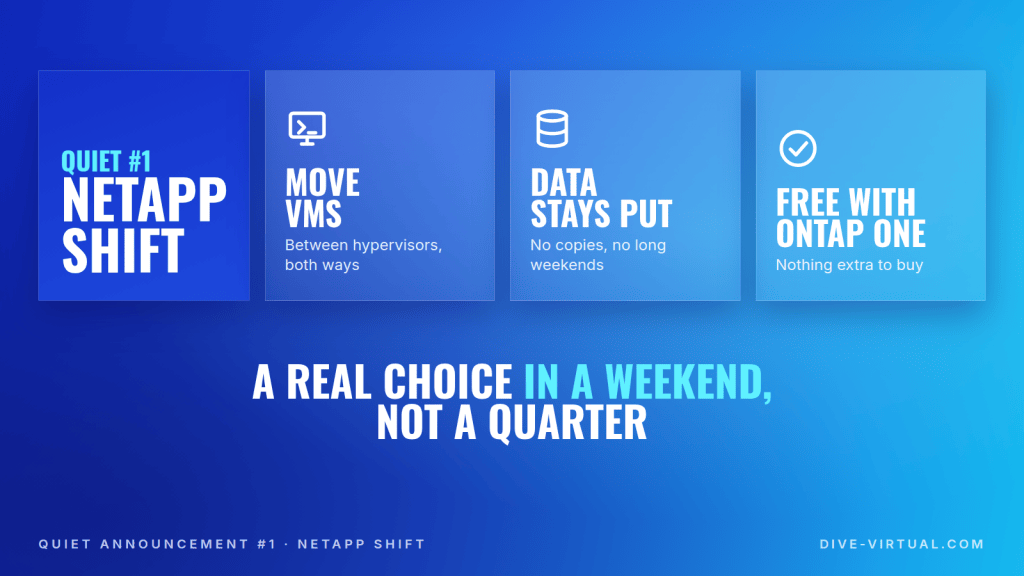
NetApp Shift is a free tool that moves virtual machines between hypervisors without copying the data. It is included in the ONTAP One license, so there is nothing extra to buy. It works between VMware, Red Hat OpenShift, Proxmox, Hyper-V, Azure Local and the cloud platforms. On top of that, the ONTAP integration with Nutanix is planned to be generally available this fall.
Why does this matter? In most migration projects, the scary part is not the hypervisor. It is the data. Terabytes that need to be copied, checked and copied again, often over a weekend with too much coffee. With a zero-copy approach the data stays where it is, and only the virtual machine format changes. A migration project becomes a conversion.
Now, I spend a lot of my time with VMware Cloud Foundation, so don’t read this as “everybody should leave VMware”. That is not my point. My point is that having a real choice is the best position to be in, whether you stay or go. And a choice that costs you a weekend instead of a quarter is a real choice.
2. The console comes home
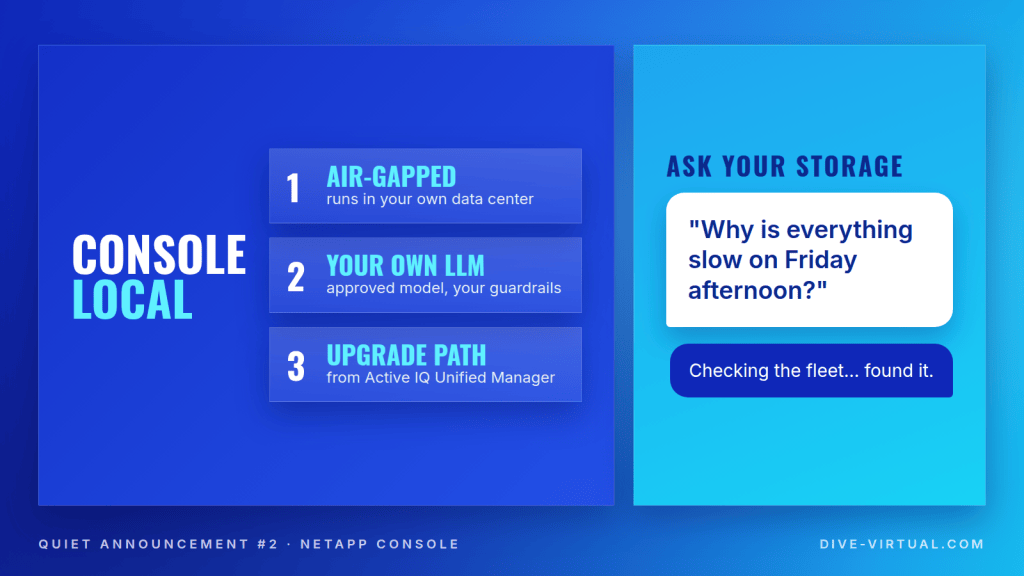
NetApp Console now comes in two flavours. Next to the cloud version, there is Console Local, which you install in your own data center. It even runs fully air-gapped. And if you use Active IQ Unified Manager today, there is an upgrade path to it, so no rip and replace.
This sounds like a small thing, but in Dutch healthcare and the public sector it is not. I have been in more than one meeting where a cloud-based management plane was a hard no from the security officer. End of discussion. Now that discussion can start again, with the same tooling on-premises.
The second part is the new ChatOps interface. You can ask the console to create a volume, set up replication or find out why a workload is slow, in plain language. The clever bit is that it works with your own LLM, the one your security team already approved. NetApp does not ask them to approve yet another AI model. That is smarter than it looks. I am curious, though, what it answers when you ask why everything is slow on Friday afternoon.
3. A free look in the attic
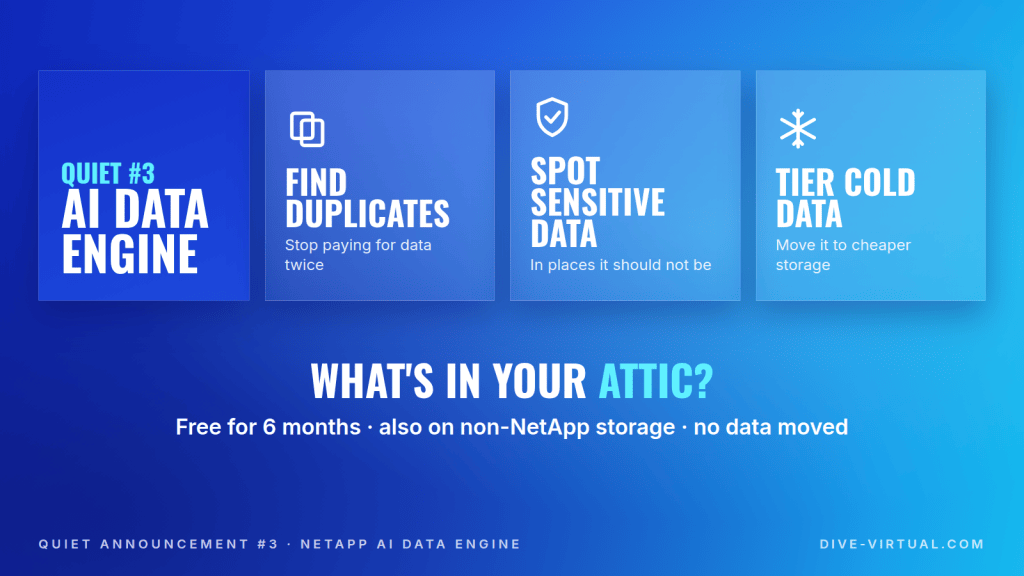
Every organisation has an attic. File shares nobody dares to delete, old project folders, and that one S3 bucket from a proof of concept in 2021. The NetApp AI Data Engine can now scan all of that, also when it lives on storage from other vendors, over NFS, SMB and S3. Nothing gets copied or moved. And NetApp gives it away free for the first six months.
The official story is about AI: before you can feed data to an AI agent, you need to know what you have. That is true. But I think the side effects are even more interesting. You find sensitive data in places where it should not be. You find the same data stored three times, and you pay for it three times. And you find cold data that can move to a cheaper tier tomorrow.
A free inventory with no migration and no commitment is about the lowest-risk first step I can think of. If you only do one thing after reading this post, do this one.
The fine print that made me smile
Keystone, NetApp’s storage-as-a-subscription offer, got some updates that nobody puts on a big screen. The efficiency guarantee now makes compression and deduplication ratios part of the contract. There is a 90-day price hold when you add capacity after reaching 80% consumption. And there is a six-nines availability SLA with automatic credits when NetApp misses it. In a year where hardware and memory prices only go up, that kind of predictability is worth more than a fast demo.
Then there is Keystone Sovereign. Your data, your telemetry and even the support staff stay inside Europe. A very welcome step. The small catch: it starts in November with France and Germany, and other countries follow later. So for my Dutch readers, it is not here yet. That is a good question to ask your NetApp contact this month.
And yes, Novus
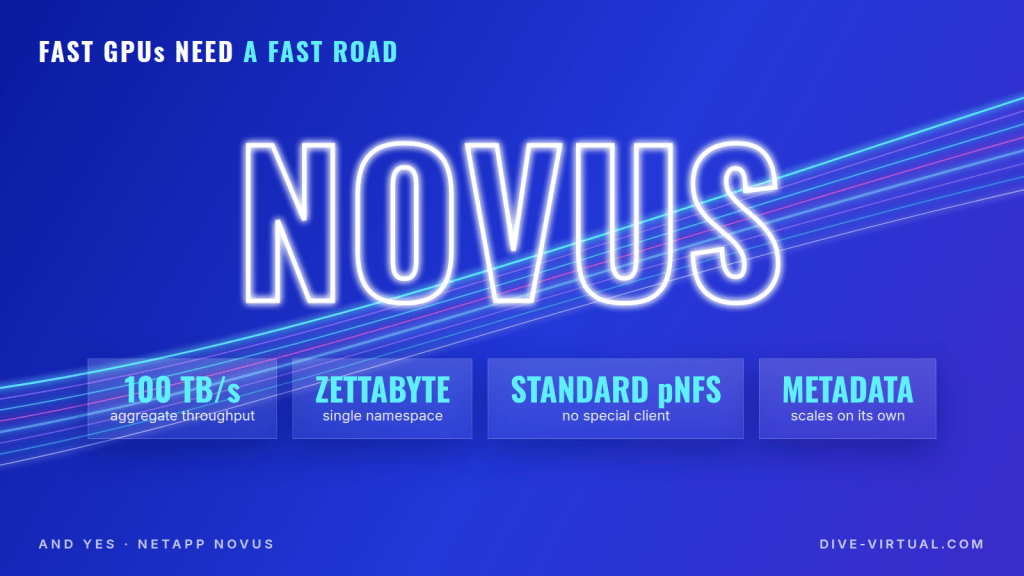
I promised not to write about the big number, but one thing about Novus is worth your time. Arindam Banerjee compared fast GPUs on traditional storage to a sports car on a dirt road. The road in this story is not the disks or the network. It is the metadata: the system that keeps track of where every file is. With thousands of GPUs and agents asking for files at the same time, that part breaks first.
Novus solves this by splitting metadata off and letting it grow on its own, using standard pNFS that is already in every Linux kernel. No special client software on thousands of servers. The planned acquisition of PEAK:AIO, the company behind this metadata technology, shows NetApp means business here.
Here is the lesson for the rest of us. Even at that crazy scale, the real problem is not raw speed. It is knowing what data you have and where it lives. Sounds familiar? That is exactly what the attic in point three is about, just a few zeros smaller.
What I take home from Insight
On the surface, Insight 2026 was all about AI. Underneath, I heard one message again and again: don’t throw away what you already have. Keep your data where it lives. Keep your choices open. Keep your control close to home.
That is not the message that gets the most likes. But it is the message that helps most organisations I work with on a normal Monday morning.
Funny enough, it is the same lesson I took home from our own party at ITQonnect Days. You don’t reach 25 years by throwing everything away every few years. You get there by building on what works, and by daring to change the rest.
So here is my question to you. Which of these three would you try first: the free exit ticket, the console at home, or the look in the attic? Let me know in the comments. And if you are curious what is hiding in your own attic, send me a message. I will bring the coffee.


Leave a Reply